
Written by Dr. Tariq Jabaiti, DDS | Oaks Dental, Calabasas, CA
Key Takeaways
- Traditional putty impressions are subject to dimensional distortion as the material cures and is transported, meaning retakes are more common than most patients realize.
- A 3D intraoral scanner uses structured light to capture thousands of micro-images per second, generating a precise digital model of your teeth in minutes, with nothing placed in your mouth.
- Peer-reviewed research suggests digital impressions are measurably more accurate than traditional methods, a difference that matters most for precision cosmetic work like porcelain veneers and Invisalign.
- At Oaks Dental, a 3D intraoral scan is included as standard in our $99 New Patient Special, not an upgrade, not an add-on.
At Oaks Dental, a 3D intraoral scanner replaces traditional putty impressions entirely. A small handheld wand maps your teeth digitally in two to five minutes, with no material in your mouth, no gagging, and no waiting for a physical mold to set.
That might sound like a minor comfort upgrade. It isn’t.
The impression is the step in dentistry that most commonly fails. Putty shifts as it cures. Patients move. Molds distort in transit. The downstream result, a crown that needs adjustment, a veneer that doesn’t seat cleanly, an aligner tray that doesn’t track correctly, starts the moment that impression material goes in. For patients in Calabasas investing in porcelain veneers or Invisalign, a compromised impression isn’t just an inconvenience. It’s a costly reset on work you haven’t even started yet.
Here’s how the technology works, and why the precision gap matters more than most dental content will tell you.
The Problem with Traditional Putty Impressions
Traditional dental impressions use alginate or polyvinyl siloxane, a thick, paste-like material loaded into a tray and pressed over your teeth for several minutes while it sets. If you’ve experienced this, you know it. The pressure. The material is creeping toward the back of your throat. The instruction to breathe through your nose while your brain is doing the opposite.
For patients with a sensitive gag reflex, it can be genuinely distressing. For everyone else, it’s at minimum unpleasant, and often repeated.
What most patients don’t know is that putty impressions have an accuracy ceiling built into the process. The material continues to change dimensionally as it cures and as it’s transported to the lab. A physical mold shipped across town is not the same mold that came out of your mouth an hour prior. That variation is a structural limitation of the method, not a skill issue with your dentist.
Dental practices continue to use traditional impressions primarily because the equipment is inexpensive and the workflow is familiar. For straightforward procedures, the margin of error is often acceptable. But “acceptable” and “precise” are not the same standard, and for cosmetic dentistry, the difference is visible.
How a 3D Intraoral Scanner Actually Works
What the Wand Captures
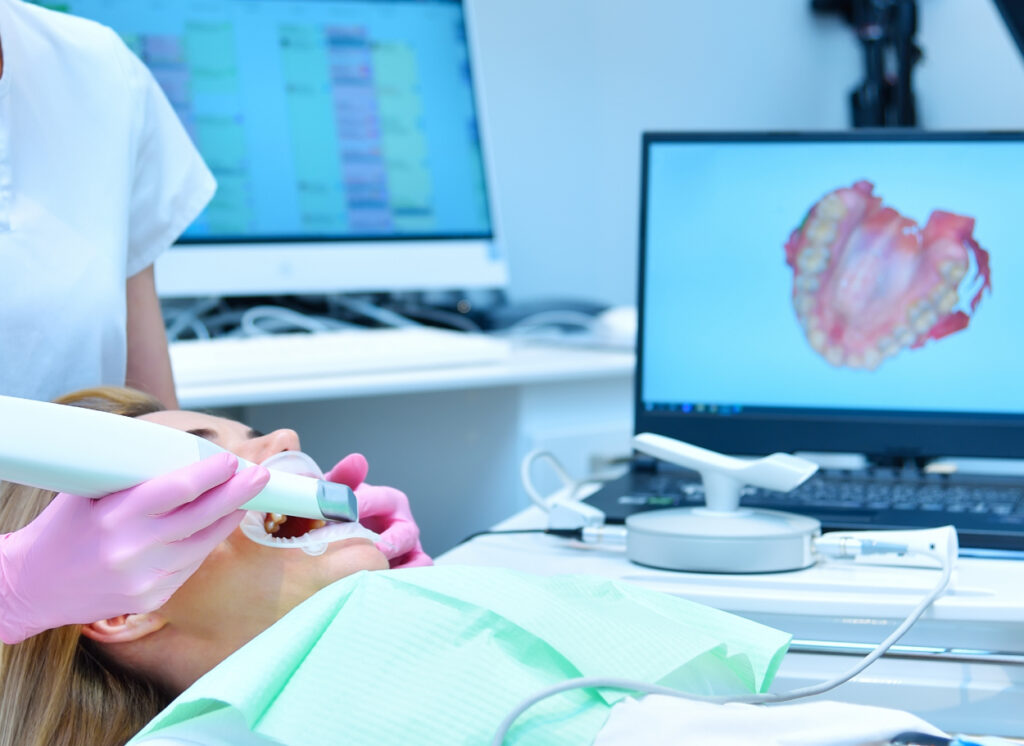
An intraoral scanner is a handheld device, roughly the size of an electric toothbrush, that uses structured light and a high-resolution camera to capture thousands of images per second as it moves across your teeth and gum tissue. The device is never pressed against your teeth. There is no material involved. Nothing sets.
In real time, those images are stitched together by the software into a precise 3D model that appears on a chairside monitor as the scan progresses. You can watch your own teeth take shape on screen while it’s happening. Most patients find this unexpectedly interesting.
What Happens to the Scan Data
Once the scan is complete, the digital file is transmitted electronically, either to our dental lab for fabrication of crowns, veneers, or bridges, or directly into our in-office CAD/CAM system for same-day crown production. There is no physical mold to ship, no material to distort in transit, and no degradation between capture and fabrication.
The time between impression and result compresses from days to hours, or, in the case of same-day crowns, to a single visit.
Are Digital Dental Impressions More Accurate Than Traditional Impressions?
Research published through the National Institutes of Health indicates that intraoral scanners produce impressions with measurably higher dimensional accuracy than traditional putty methods, particularly for full-arch scans. ¹
For most general restorative work, this difference is meaningful but not always critical. For precision cosmetic procedures, it’s the difference between a result that fits and one that requires adjustment before it ever reaches your mouth.
Porcelain veneers are fabricated to specifications in fractions of a millimeter. A veneer that arrives from the lab with even minor dimensional variance, caused by putty shrinkage or mold distortion in transit, will require chairside adjustment before bonding. That adjustment adds chair time, introduces unpredictability, and in some cases affects the final cosmetic result.
The same logic applies to Invisalign. Each aligner in your treatment sequence is manufactured to a precise digital model of your teeth at a specific stage of movement. If the original model is slightly off, every aligner in the sequence compounds the error. A precise digital scan at the start of treatment means your trays track correctly from the first one to the last.
For Calabasas patients investing in their smile, the intraoral scan isn’t a comfort feature. It’s the foundation that the rest of your treatment is built on.
Our $99 New Patient Special includes a complimentary 3D intraoral scan as a standard part of your first visit, not an upgrade, not a line-item addition. If you’re considering a smile makeover, Invisalign, or simply want to start your care with a precise baseline, [schedule your visit at our Calabasas dental studio] to experience digital imaging firsthand.
Which Dental Procedures Use Intraoral Scanning at Oaks Dental?
Unlike practices that reserve digital scanning for a single procedure type, we use intraoral imaging across the full range of care we provide:
- Porcelain veneers and smile makeovers, where dimensional precision directly affects cosmetic outcome
- Invisalign treatment, where an accurate starting model determines how well every aligner in your sequence seats and tracks
- Same-day crowns, where the scan feeds directly into our CAD/CAM system, allowing your permanent crown to be designed, milled, and placed in a single appointment
- Bridges and implant planning, where spatial accuracy matters for both fit and long-term integration
- New patient exams, every new patient receives a 3D intraoral scan as part of our $99 New Patient Special, because an accurate baseline model is foundational to your care, regardless of what brings you in
This is not technology reserved for complex cases. It’s the standard we begin every patient relationship with.
What Does a Digital Dental Scan Feel Like?
Two to five minutes. Nothing in your mouth except a small wand that moves along your teeth without pressing against them. No material. No pressure on your soft palate. No trigger for the gag reflex.
Most patients describe it as unremarkable, which is exactly the point. The procedure that historically caused the most discomfort in a standard dental appointment has been replaced by something that causes almost none.
The scanner doesn’t contact your teeth. It doesn’t reach toward your throat. It reads light, not molds. Patients who previously needed breaks, repositioning, or multiple attempts with traditional impressions typically complete a digital scan in a single uninterrupted pass.
If you have avoided certain dental procedures specifically because of the impression step, it’s worth knowing that the step has changed.
What To Do Next
Modern dentistry means your impression is as comfortable and as precise as the rest of your visit. At Oaks Dental, we built our new patient experience around that standard from the beginning. The 3D intraoral scan isn’t something we added to stand out. It’s something we incorporated because, for the level of care we’re committed to delivering, particularly for cosmetic work, anything less isn’t sufficient.
If you’re evaluating a smile makeover, Invisalign, or simply looking for a dental home that takes your time and your outcomes as seriously as your comfort, we’d be glad to show you what that experience actually feels like.
Schedule Your Visit at Our Calabasas Dental Studio
Your first appointment includes a comprehensive exam, digital X-rays, and a complimentary 3D intraoral scan, all for $99. No pressure. No unexpected recommendations. Just a clear, precise picture of your smile and an honest conversation about your options.
Book Online | Call (818) 431-2000
5000 Parkway Calabasas, Suite 308, Calabasas, CA 91302
This article is for informational purposes only and does not constitute dental advice. Please consult with Dr. Jabaiti or a licensed dental professional for personalized recommendations regarding your dental care.
Frequently Asked Questions
Is an intraoral scan painful or uncomfortable?
No. A 3D intraoral scan involves no material, no pressure, and no contact with your soft palate or throat. The scanner wand moves along your teeth without touching them. Most patients complete the scan in two to five minutes without any discomfort, and it does not trigger the gag reflex in the way that traditional putty impressions commonly do.
How long does a digital dental scan take?
For most patients, a full-arch digital scan takes approximately two to five minutes. The 3D model appears on screen in real time as the scan progresses, and the digital file is ready for transmission or in-office fabrication immediately upon completion, with no curing time, no shipping, and no waiting.
Can intraoral scanners be used for Invisalign and veneers?
Yes, and for both procedures, the accuracy of the scan is especially consequential. For Invisalign, the digital model provides the precise baseline from which your full aligner sequence is manufactured; an accurate model means your trays track correctly from start to finish. For porcelain veneers, scanner precision directly influences how well the veneers fit at placement, reducing the need for chairside adjustment. At Oaks Dental, digital scanning is used as a standard part of care.
 You Broke a Tooth. Here’s How You Walk Out of Our Calabasas Studio With a Permanent Crown, Today